
Camilo José Cela on Dionís Bennàssar
“One breathes through the wound, one sings through the wound, one paints through the wound, and one loves through the wound that adorns the bottom of the heart with its lips of blood and its beat. And in the painting of Dionís Bennàssar there blows the wind that is born, like a tender and abundant river, in that wound and in its violent swayings.”
In 1992, to mark twenty-five years since the painter’s death, the Ajuntament de Pollença invited Camilo José Cela to write for the commemorative catalogue. Cela had won the Nobel Prize in Literature three years earlier. He had also been a Mallorcan resident since 1954, when he left Madrid for the island and spent his first months living in Pollença itself.
His text is titled Palabras dichas con Dionís Bennàssar en el recuerdo, words spoken with Dionís Bennàssar in memory.
Cela builds it around two sayings attributed to Leonardo da Vinci: that painting is poetry seen and not heard, and that poetry is painting heard and not seen. He disputes both. In Pollença, he argues, the two share the same shuddering accents, and he calls the town
“a latitude of poets and of painters, each one striking true in his own fever, and each one anchored in his orbit inhabited by mystery.”
Of the painter at work, he writes that Dionís took hold of the world by the throat, and that
“the world reflected in his paintings is not the one he saw but the one he will see.”
That, Cela continues, is how sacred history was written, through premonitions and forebodings, and how the Odyssey was written, the Parthenon raised, the Earth circumnavigated and the Moon reached. He calls it an endless path, and a hopeless one, that carries us above death and its insults to the eternal boundaries of beauty, which neither ceases nor grieves.
He then offers the description that has stayed attached to Dionís ever since:
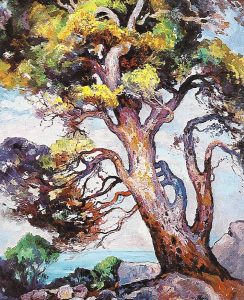
“Dionís Bennàssar was an epicurean painter; perhaps it is clearer to call him a pagan Pollencí in love with beauty and with life, who painted trees and flowers, clouds of the sky and waves of the sea, imaginings, women and ghosts with the same unbridled love with which he passed through the crust of the Earth.”
And he closes on Virgil.
“Virgil, in the Aeneid, supposes that the wound lives always at the bottom of the heart. One breathes through the wound, one sings through the wound, one paints through the wound, and one loves through the wound. And in the painting of Dionís Bennàssar there blows the wind that is born, like a tender and abundant river, in that wound.”
Cela could not have known how precisely he had described his subject. Fifty-two years earlier, in the catalogue for Dionís’s 1940 exhibition at the Galeries Costa in Palma, the painter Tito Cittadini had written of the bullet that ended Dionís’s working right hand: el tribut de la seva sang portà com a conseqüència el tribut del seu talent. The tribute of his blood brought as a consequence the tribute of his talent.
And in 1946 Dionís himself, writing privately for his son in a manuscript that remained unpublished in the family archive, had put it more plainly still. Drawing and painting, he wrote, were el camino expansivo de un supuesto afligido porvenir: the expanding path out of a future he expected to be an afflicted one.
Camilo José Cela (1916–2002)
Nobel Prize in Literature, 1989
From Palabras dichas con Dionís Bennàssar en el recuerdo [Words spoken with Dionís Bennàssar in memory], written for the catalogue Dionís Bennàssar, 25 anys després, Ajuntament de Pollença, 1992