
Did Dionís invent his colours, or did he see them?
When people stand in front of a Dionís Bennàssar painting, they often notice first how daring the colour is. There are violets in the shadow of a pine, greens in a midday sky, turquoises and reds in the merging waves. It’s easy to put him alongside the Expressionists and the Fauves, painters who bent colour to express feeling.
There is another way to look at it.
We learn to see what we live among. The Scots language has a word for every kind of weather: smirr for fine drizzle, dreich for a grey, wet day, drookit for soaked to the skin. Researchers at the University of Glasgow logged 421 Scots words for snow alone. Inuit and Yupik languages have dozens of separate terms for snow and ice, because telling one kind from another can decide whether a journey is safe. Someone raised in a rainforest lives among more shades of green than a city child will ever need to name. In one well-known study, Russian speakers, who have separate words for light blue and dark blue, were quicker than English speakers to tell those blues apart.
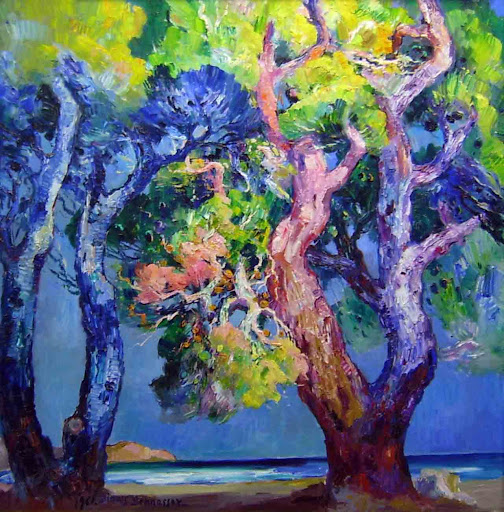
Puerto Pollensa – 1961 – Dionís Bennássar
Dionís was born in Pollença in 1904 and spent most of his life here, in a place where the colour range is unusually wide. He grew up between mountain and sea, among pine, olive, red earth, white stone, almond blossom and a sky that changes from hour to hour. He learned the whole spectrum, and he learned it in detail. Visiting painters arrived with eyes trained in other environments, many of them from cities. Where others may have seen a blue sea or a green pine, he was perhaps seeing the lavender in the water, the gold along the edge of the needles, and the warm light thrown back between stone and shade.
So perhaps his colour is not exaggeration at all. To someone from here, perhaps it is simply accurate.
Look again. Then step outside into the light and see whether you can find his colours.